
Buy Personalized Dog Breed Wall Art: A 2026 Guide
Table of Contents
- Why Personalized Dog Breed Wall Art Beats Generic Dog Prints
- Choosing Your Style: From Silhouette Art to 3D Relief
- What to Expect From a Custom Pet Portrait UK Service
- Photo Quality Troubleshooting: Getting the Best From Your Upload
- Framed Canvas or Unframed Print? Materials, Sizing and Sustainability
- Dog Lover Home Decor Ideas: Where Breed-Specific Art Actually Works
- How to Style Pet Portraits in a Gallery Wall
- Frequently Asked Questions
Last Updated: September 10, 2026
Why Personalized Dog Breed Wall Art Beats Generic Dog Prints
If you want to buy personalized dog breed wall art, the difference comes down to specificity. A whippet in full flight or a border terrier's alert expression speaks to your dog and no one else's. This guide from Proud Pup Club covers how to choose a piece that actually looks like your breed.
A personalized dog print captures the ear set, tail carriage and coat colouring that made you stop and look twice, where generic pet imagery flattens all of that into a cartoon.
Breed-specific wall art becomes part of the room's character, reading as deliberate decor rather than novelty merchandise.
Choosing Your Style: From Silhouette Art to 3D Relief
Most sellers offer one house style and expect you to like it. That is backwards: the style should follow the room, the dog's coat, and how much visual weight you want on the wall. Here is a working comparison of the styles you will encounter.
Silhouette art
A single-colour profile, usually black or a deep neutral, cut cleanly against a light background. It is the most forgiving style for awkward spaces because it reads at a glance and does not compete with patterned wallpaper.
- Best for: Hallways, stairwells, small rooms, and anyone who wants the breed to be recognisable without the piece dominating.
- Weakness: It strips out coat colour and eye detail, so two similar breeds can look alike. A whippet and an Italian greyhound silhouette can be hard to tell apart at a distance.
- Sizing note: Silhouettes work well small. A 30x40 cm piece is often enough; going larger can make the negative space feel empty.
Line illustration
A continuous or broken line drawing capturing the dog's outline and key features with minimal strokes. Lighter and more playful than a silhouette.
- Best for: Kitchens, hallways, children's rooms, and gallery walls where you want variety without heaviness.
- Weakness: Line work depends on a confident original drawing. A weak line looks wobbly rather than expressive, so ask to see previous examples in the exact style.
- Sizing note: Line art scales up well because there is little detail to lose. A 50x70 cm print holds together fine.
Watercolour
Soft washes of colour that suggest the coat rather than reproduce it literally. The most popular style for memorial pieces.
- Best for: Bedrooms, memorial tributes, and rooms with a soft or neutral palette.
- Weakness: Colour accuracy is looser by design. If you want the exact brindle pattern or the precise shade of a liver nose, watercolour will interpret rather than replicate.
- Sizing note: Watercolour benefits from a mat and frame. An unframed watercolour print can look unfinished on a bare wall.
Oil and acrylic style
Rich, layered colour with visible brush texture, reading as a traditional portrait.
- Best for: Studies, dining rooms, and anyone who wants the piece to feel like an heirloom.
- Weakness: It is the hardest style to get right from a single photo, because the artist is inventing texture and light. Expect to supply more reference images.
- Sizing note: These pieces want space. A large canvas in a small room will overwhelm it.
Pop art and graphic
Bold blocks of colour, high contrast, and a poster-like feel, often using two or three strong colours.
- Best for: Modern interiors, home offices, and anyone who wants the art to be a talking point.
- Weakness: It is the least subtle option and can clash with warm, traditional decor. Choose your colour palette to match the room, not just the dog.
- Sizing note: Graphic styles suit square formats and can be grouped in pairs or grids.
Minimalist single-line
A single unbroken line tracing the dog's form, even more stripped back than line illustration.
- Best for: Scandi-style interiors, rented flats where you want something light to hang, and small prints.
- Weakness: Very little room for error. If the line is not confident, the piece looks like a scribble.
3D relief and hand-finished pieces
Sculpted depth, often with a metallic finish on raised elements. Statement pieces rather than wall fillers.
- Best for: Feature walls, stairwells, and rooms where the art is the focal point.
- Weakness: Higher cost, longer lead time, and they need good lighting to show the relief. A dark corner wastes the effect.
How to choose in practice
Work through this order:
- Match the room first. A traditional room with warm wood and patterned textiles will fight a pop-art print; a minimalist room will swallow an oil portrait.
- Match the dog's coat. Breeds with dramatic markings (dalmatians, border collies, rottweilers) suit styles that show pattern; solid-colour breeds suit silhouettes and line work.
- Match the purpose. A memorial piece usually wants watercolour or oil; a fun gift for a new puppy often suits pop art or line illustration.
- Match the budget last. Let budget rule out the most expensive options once you know what you actually want.
A note on digital downloads as a style test
If you are unsure, a digital download is the cheapest way to see how a style suits your dog before committing to a physical piece. Print it at home or locally, live with it for a week, and if it still works, commission the canvas or framed version.
What to Expect From a Custom Pet Portrait UK Service
A custom pet portrait UK service should ask for clear photos, confirm the artistic style, and show you a proof before production. If a service skips the proof stage, walk away.
Lead times vary by medium: digital downloads arrive within days, while canvas and framed pieces take longer because they're produced to order. Ask for the timeline in writing before you pay.
Proud Pup Club produces everything made to order, which avoids warehouse waste but means you should plan ahead rather than order at the last minute.
Photo Quality Troubleshooting: Getting the Best From Your Upload
Good source photos decide how good the finished artwork looks. A blurry phone snap cannot become a crisp portrait.
Work through this checklist before uploading:
- Use the highest resolution version of the photo you have
- Choose natural daylight over flash or indoor lamps
- Photograph your dog at eye level, not from above
- Capture the full head and, if possible, the chest
- Avoid heavy filters, which distort true coat colour
- Send two or three angles so the artist can read the breed properly
If your only photo is low quality, ask the service whether they can work from it. A good artist will tell you honestly rather than deliver something soft and muddy.
Framed Canvas or Unframed Print? Materials, Sizing and Sustainability
The frame decision is really three stacked decisions: what the art is printed on, how it is finished, and how it will hang. Get them right and the piece looks intentional; get them wrong and even a good portrait looks like a poster.
Print substrate: what the art actually sits on
- Matte paper: Absorbs light rather than reflecting it, so it suits bright rooms and avoids glossy glare.
- Satin or lustre paper: A middle ground with more colour depth than matte and less glare than gloss. A safe default for most rooms.
- Canvas: A woven texture that adds depth and makes the piece feel like a painting. More forgiving of imperfect walls because it does not need glass.
- Fine art giclée: A high-resolution inkjet process using pigment inks rather than dye, which are generally more fade-resistant, useful in a sunny spot.
Ask the seller what ink type they use. If they cannot tell you, that is a signal about how much care goes into the product.
Framed vs unframed: the real trade-offs
| Option | Best for | Trade-off |
|---|---|---|
| Framed canvas | Ready-to-hang gifts | Less frame flexibility |
| Unframed print | Matching existing frames | Framing cost added later |
| Digital download | Testing a design cheaply | You handle printing |
| 3D relief | Statement walls | Higher cost, longer lead time |
A framed canvas arrives finished but locks you into the seller's frame; an unframed print matches your decor but framing costs extra. For a gift with a fixed date, framed is usually safer.
Sizing: the mistake most people make
A single small print on a large blank wall looks lost. A common rule of thumb is to fill roughly two-thirds to three-quarters of the intended wall space, measured across the width of the furniture below it (thesprucecrafts.com).
Practical sizing guide:
- Above a sofa: The art should span about two-thirds of the sofa's width. For a 180 cm sofa, aim for a piece or grouping around 120 cm wide.
- Above a console or sideboard: The art should be narrower than the furniture, not wider.
- Hallway or narrow wall: Go vertical, a tall, narrow piece suits a tight space better than a wide one.
- Gallery wall: Measure the total footprint first, then divide into frames. Spacing frames too far apart makes the group read as scattered rather than connected.
Hang art so the centre of the piece sits at roughly eye level, which for most people is around 145-150 cm from the floor (moma.org). Above furniture, leave 15-25 cm between the top of the furniture and the bottom of the frame (bhg.com).
Sustainability: what to actually ask
Sustainability in wall art comes down to how the piece is produced, what it is made from, and how it is shipped.
- Made-to-order vs stock: Made-to-order pieces avoid the warehouse waste of mass-producing designs that do not sell. Ask whether the piece is printed after you order or pulled from a shelf.
- Paper sourcing: Look for FSC-certified paper or board, an independent scheme confirming the fibre comes from responsibly managed forests.
- Inks: Water-based or pigment inks are generally lower-impact than solvent-based alternatives. Some sellers use recycled or recyclable packaging; ask.
- Frames: Solid wood from certified sources, or recycled or reclaimed wood, beats high-volume plastic mouldings. If the frame is wood, ask where it comes from.
- Shipping: Flat-packed or rolled prints use less packaging than boxed framed pieces. Rolled in a tube is usually the lowest-waste option for unframed orders.
A well-made piece that lasts twenty years is more sustainable than a cheap one you replace in two.
A quick decision path
- Sunny room? Choose matte or satin paper with pigment inks, or canvas.
- Gift with a deadline? Choose framed canvas.
- Existing frames you want to match? Choose an unframed print.
- Testing a design? Choose a digital download.
- Want the lowest-waste option? Ask for FSC-certified paper, water-based inks, and rolled shipping.
Dog Lover Home Decor Ideas: Where Breed-Specific Art Actually Works
Dog lover home decor ideas work best when the art feels intentional rather than themed. One strong breed-specific piece beats five novelty items.
Placement ideas that hold up:
- Above a hallway console, where a silhouette reads clearly at a glance
- In a home office, where a personalised dog print keeps you company on calls
- Beside a dog bed or feeding station, tying the practical corner into the decor
- In a bedroom, where a smaller unframed print suits a calmer palette
Scale matters more than most people expect. Measure the wall, then choose a size that fills roughly two-thirds of the intended space.
How to Style Pet Portraits in a Gallery Wall
A gallery wall makes several pieces feel like one deliberate arrangement. Start with the largest piece as the anchor, then build outward with smaller frames in mixed sizes.
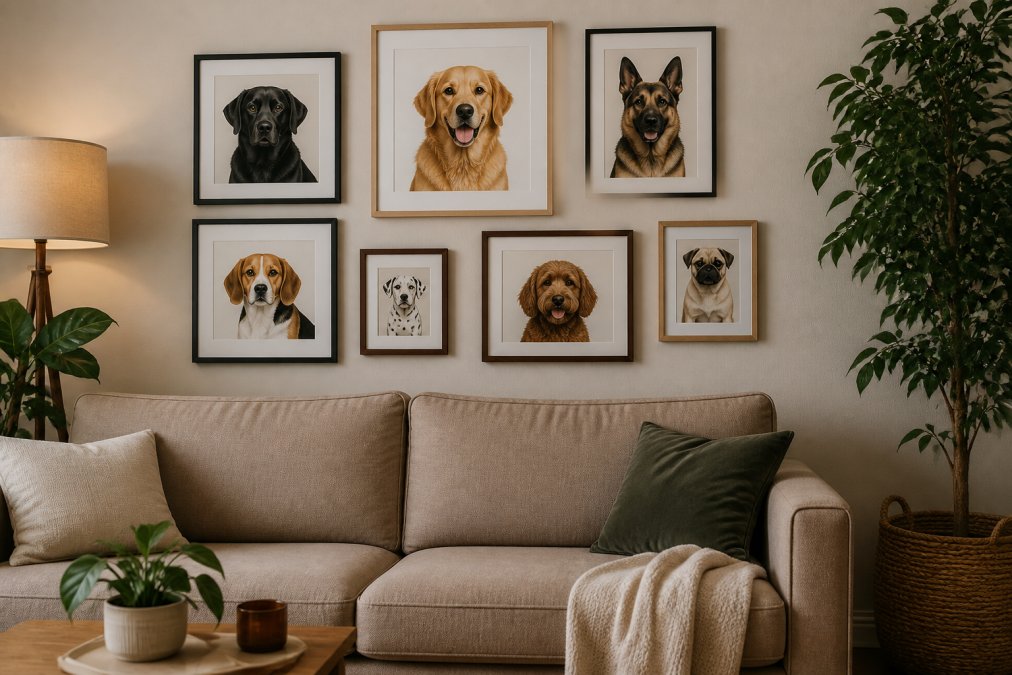
Keep a consistent thread: matching frame colour, a shared palette, or a single artistic style. Lay the arrangement on the floor and photograph it before committing to nails.
If you're building the wall over time, buy the anchor piece first and let the rest follow, gallery walls that grow naturally look better than ones assembled in an afternoon.
Frequently Asked Questions
What are the best styles for personalized dog breed wall art?
Silhouette art, 3D relief and hand-finished pieces with gold leaf accents all work well, and each suits a different room. Silhouettes stay subtle in minimalist interiors, while 3D relief adds texture to a plain wall. If you want a softer look, an artistic rendering of your dog's face in watercolour or line art reads as a custom pet portrait rather than merchandise. Think about your existing decor first, then pick the style that matches it.
How do I choose the right size for dog breed wall art?
Measure the wall space before you order. A single piece above a sofa usually needs to span roughly two-thirds of the furniture's width to look balanced, while gallery wall arrangements mix sizes so no single print dominates. For narrow hallways, keep pieces under 40cm wide. If you are unsure, order a digital download first to test scale, or ask the seller for a mock-up before committing to a framed canvas.
Can I get personalized dog art framed in the UK?
Yes. Many made-to-order sellers offer framed canvas and framed print options with UK delivery, so the piece arrives ready to hang. Framed canvas tends to suit larger statement pieces, while a slim frame works better for smaller gallery wall prints. Check the frame depth and hanging hardware before ordering, and confirm whether the seller ships frames assembled or flat-packed for you to mount yourself.
What information do I need to provide for a custom dog portrait?
You will need a clear, well-lit photo of your dog, ideally showing the face straight on with no heavy shadows or filters. Include your dog's breed, name if you want it added, and any markings that make them recognisable. Tell the artist which artistic style you prefer and the finished size. Good photo upload guidance from the seller makes a real difference, so read their submission notes before sending anything.
Choosing breed-specific art means picking a style, a medium and a size that suit your actual home, not just your dog. It takes a little more thought than adding a generic print to a basket, and the result is a piece you'll still be happy with years later. Proud Pup Club makes every item to order, designs each piece by people who own and love these breeds, and ships worldwide with secure checkout. Shop your breed and find the piece that finally looks like your dog.