
How to Measure Your Dog for Custom Clothing: 2026 Guide
Table of Contents
- Why Accurate Measurements Matter for Custom Dog Clothing
- Tools You Need Before You Start Measuring
- A Complete Dog Clothing Size Guide: What to Measure
- How to Measure Dog Back Length Step by Step
- Measuring Dog Chest Girth: The Widest Part Matters Most
- Breed-Specific Measurement Nuances and Specialised Gear
- Common Measuring Mistakes and How to Avoid Them
- Frequently Asked Questions
Last Updated: September 19, 2026
Why Accurate Measurements Matter for Custom Dog Clothing
Getting the right fit starts with one thing: a soft measuring tape and five quiet minutes. According to Battersea's advice on keeping dogs calm during handling, most dogs settle faster when measured on a non-slip surface at home rather than on a vet table. That matters, because a custom-stitched coat cut to the wrong numbers will gap at the neck or ride up over the shoulder blades, no matter how good the sewing is.
Tools You Need Before You Start Measuring
You need three things, none expensive. A soft measuring tape is the only tool that matters, because a rigid tape will not follow the curve of a dog's body.
Gather these before you call your dog over:
- A soft measuring tape (fabric tape, at least 150 cm)
- A notebook or phone for recording each number
- A few treats to reward a standing position
- A second pair of hands, if your dog wiggles
A Complete Dog Clothing Size Guide: What to Measure
Every dog clothing size guide comes down to three numbers: neck circumference, chest girth, and back length. Get these right and almost any garment will fit.
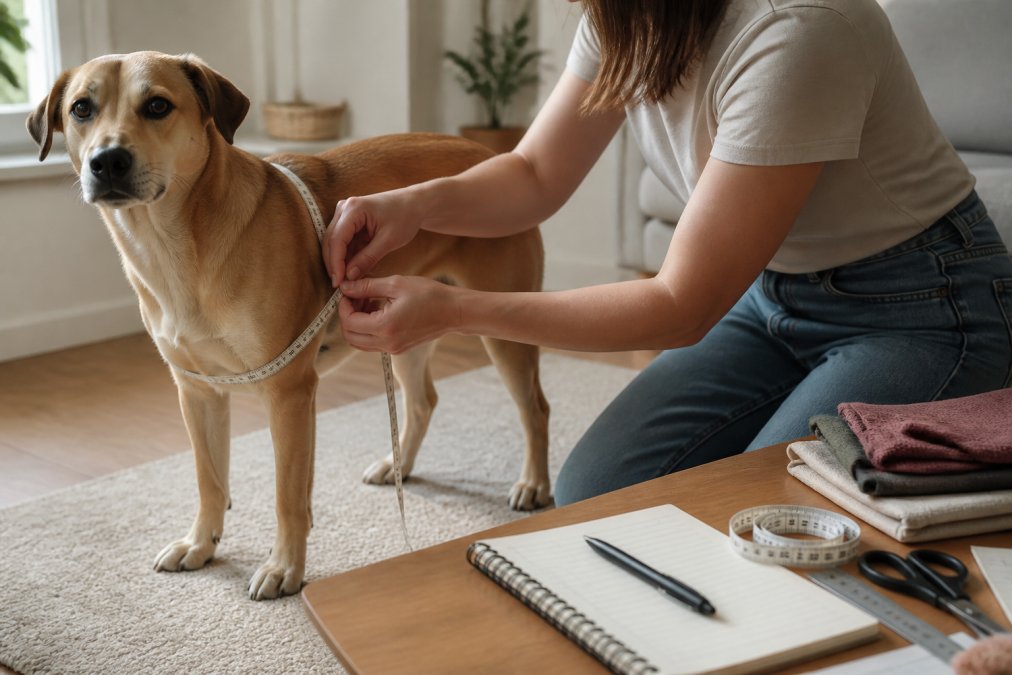
Neck Circumference
Measure the neck at the base, where a collar naturally sits. Wrap the tape snug against the fur, then slide two fingers under it, the two-finger rule, so you do not order a collar that chokes.
Chest Girth
Chest girth is the distance around the widest part of the chest, just behind the front legs. It decides whether a coat closes properly, and a snug fit keeps the garment from twisting when your dog walks.
Back Length
Back length runs from the base of the neck to the base of the tail, along the spine. Measure it with your dog in a natural stance, standing, not sitting or curled up.
| Measurement | Where to Place the Tape | Why It Matters |
|---|---|---|
| Neck circumference | Base of the neck | Stops the collar or hood rubbing |
| Chest girth | Widest part of the chest | Decides whether the coat closes |
| Back length | Base of neck to base of tail | Sets the garment length |
How to Measure Dog Back Length Step by Step
Learning how to measure dog back length is the step most owners rush, and it shows in the fit. The key is a natural stance: standing square on all four feet, head level, weight evenly spread. A sitting, lying, or leaning dog gives you a spine curve that adds or removes centimetres.
The two landmarks, precisely
Most guides say "base of the neck to base of the tail" and leave it there. That vagueness is where errors creep in.
- Front landmark: the bony ridge at the top of the shoulder blades, where the neck meets the back. Run your fingers down the back of the neck until you feel the first prominent vertebra that does not move when the dog turns its head. That is your start point. Do not start at the collar line, that sits lower and further forward, and will make the garment too long.
- Rear landmark: the base of the tail, where the tail meets the body. Not the tip, not the middle. On a docked or short-tailed dog, find the point where the spine ends and the tail begins by feel.
Step by step
- Ask your dog to stand still on a non-slip surface, and reward them for holding the position.
- Find the front landmark at the top of the shoulder blades and the rear landmark at the base of the tail.
- Lay the tape flat along the spine, following the natural line of the back rather than pressing into every dip.
- Keep the tape straight and lightly tensioned, not pulled tight, not sagging.
- Read the number at the rear landmark in centimetres, and record it immediately.
- Repeat twice more, and if the readings differ, use the longest.
Do not measure a sitting or lying dog. The spine curves, and you will order a garment that is too short. If your dog will not stand, take three readings and use the longest.
What to do when the reading falls between sizes
This is the most common fit problem, and where a tape measure alone is not enough.
- If back length is between two sizes, size up on length for coats and jumpers. A hem that sits slightly long can be adjusted or tolerated; a hem that sits short leaves the hindquarters exposed and the coat rides up when the dog walks.
- If back length is between two sizes for a harness, size to the girth, not the length. Harness straps are usually adjustable along the back, so a slightly short or long back run can be corrected at the buckle. Girth cannot.
- If the dog is long-backed and narrow-chested (Dachshund, Corgi), never size down on length to fix a loose chest. Instead, look for a garment with an adjustable belly strap or a made-to-measure option. Sizing down on length to close a gap at the chest is the most common cause of a coat that will not stay on.
- If the dog is broad-chested and short-backed (Bulldog, Boxer), never size up on length to fix a tight chest. You will end up with a coat that trails past the tail. Size up on girth and accept a slightly shorter back, or order custom.
A quick visual check before you order
Record the number in centimetres alongside your neck and chest girth figures. Back length is the measurement most likely to be re-used across brands, so it is worth getting right once.
Measuring Dog Chest Girth: The Widest Part Matters Most
Measuring dog chest girth is where accuracy wins or loses. The tape must sit at the widest part of the chest, right behind the front legs, and wrap all the way around.
Watch for these traps:
- Measuring over a thick winter coat of fur without noting it
- Letting the tape sag under the belly
- Pulling too tight on a deep-chested breed
Breed-Specific Measurement Nuances and Specialised Gear
Breed shape changes how you hold the tape, and no generic chart captures that. Two dogs can share the same chest girth and still need different cuts, because girth alone ignores chest depth, neck-to-chest taper, and the ratio of back length to leg length.
- Deep-chested, narrow-waisted (sighthounds such as Greyhounds, Whippets, Lurchers). Their chest girth can be large while the waist behind the ribcage is dramatically narrower. A coat cut straight from chest to tail will billow at the middle and catch on the hind legs. Measure chest girth at the deepest point, then take a second "waist" reading just in front of the hind legs. If the two numbers differ by more than about a third, you need a garment described as a sighthound or greyhound cut, not a standard coat.
- Broad-chested, short-backed (Bulldogs, Boxers, Staffordshire Bull Terriers). The chest is wide but the back is short, so a coat sized purely on chest girth will hang past the tail. Measure back length carefully and expect to size down on length while sizing up on girth. Neck openings also need to be wider, because the neck-to-shoulder transition is thick and short.
- Long-backed, small-chested (Dachshunds, Corgis, Basset Hounds). Back length dominates. A garment that fits the chest will be far too short along the spine. Order by back length first, then confirm the chest girth sits within the garment's range. Look for coats with adjustable belly straps, because a fixed girth will either pinch or gap.
- Flat-faced, thick-necked (Pugs, French Bulldogs, Boston Terriers). The neck circumference is often close to the chest girth, so a standard collar-style opening will not go over the head. Measure the neck at its widest point, not at the collar line, and look for garments with hook-and-loop or snap closures at the neck rather than a pull-over design.
Garment type changes which number leads
Most owners assume one set of numbers fits every product. It does not. The measurement that governs fit shifts with the garment:
- Coats and jumpers: chest girth leads. Back length sets the hem. Neck circumference only matters if the garment has a high collar or hood.
- Harnesses (including mobility and support harnesses): chest girth at the deepest point behind the front legs leads, because that is where load is carried. Back length matters for the strap run, but a harness that is correct on girth and slightly short on back length is safer than one that is correct on length and loose on girth.
- Raincoats: chest girth leads, but add a little more allowance than for a jumper, because the waterproof layer sits over the top of the coat and any under-layer. A raincoat that fits snugly over bare fur will not close over a fleece.
- Recovery suits and post-surgical body suits: back length and chest girth both matter, and the fit must be close without being compressive. Measure the dog in the position they will actually be in during recovery, often lying down, because a suit measured standing can ride up when the dog lies flat. Check the garment's own sizing chart rather than a clothing chart, as recovery suits are usually sized on a different scale.
- Boots and legwear: none of the three core measurements apply. You need paw width, paw length, and the circumference of the leg just above the paw. Measure each paw separately, as front and rear paws often differ.
A practical workflow
Record your dog's three core measurements once, plus a waist reading if they are a sighthound type. For each product, compare those numbers against that product's own chart and note which measurement the manufacturer treats as the lead. If the chart does not say, match the measurement with the narrowest range first.
Common Measuring Mistakes and How to Avoid Them
- Measuring a moving dog. Wait for a calm, standing position.
- Using a rigid tape. It cannot follow the body's curve.
- Skipping the comfort allowance. A snug tape reading is not a snug garment.
- Measuring over thick fur without noting it. Note the coat length.
- Trusting one size chart for every brand. Charts vary; check each one.
- Forgetting to record the numbers. Write them down and keep them.
The two-finger rule is your safety check on the neck. If two fingers do not slide under the tape, it is too tight.
Frequently Asked Questions
How do I measure my dog for a custom-made coat?
You need three core measurements: neck circumference, chest girth and back length. Use a soft measuring tape and keep it snug but not tight. For a coat, measure from the base of the neck to the base of the tail for back length, then around the widest part of the chest for girth. Add a small comfort allowance so your dog can move freely. Record each measurement in centimetres and double-check before ordering.
What should I do if my dog is between sizes?
In-between sizing is common, especially with deep-chested breeds. Always size up on chest girth because that is the hardest area to adjust, and look for garments with adjustable straps or Velcro closures. If you are ordering custom-stitched clothing, send your exact measurements rather than picking a standard size. A made-to-order piece removes the guesswork entirely and gives a better garment fit.
How much ease should I add when measuring a dog for clothing?
The two-finger rule works well: you should be able to slide two fingers under the tape at the neck and chest. For chest girth, add roughly 2 to 4 centimetres for a snug jumper or 4 to 6 centimetres for a looser coat. Back length usually needs no extra allowance. If your dog has a thick coat, add a little more. Always check the brand's size chart for their specific comfort allowance guidance.
Why is measuring correctly important for sustainable pet apparel?
Made-to-order and custom-stitched clothing is produced specifically for your dog, so accurate measurements prevent wasted fabric and unnecessary returns. Returns create extra shipping emissions and often end up as unsellable stock. Getting the measurements right the first time means your garment fits well, lasts longer and supports the low-waste approach that sustainable pet apparel brands rely on. It also saves you the hassle of a remake.
Custom clothing only works when the numbers behind it are right, and that takes a soft tape, a calm dog, and three careful readings. At Proud Pup Club, every item is made to order, never mass-produced, so each piece is cut to the measurements you send. Our designs are created by fellow dog obsessives who celebrate specific breeds, and each order avoids warehouse waste through made-to-order production. Shop your breed and get a fit that actually honours your dog.