
How to Spot Quality Cotton Apparel: 2026 Guide
Table of Contents
- Why Cotton Quality Matters More Than Ever in 2026
- Signs of High Quality Clothing: The 7-Point Checklist
- How to Check Fabric Quality Before Buying: A Step-by-Step Guide
- Fabric Composition: Extra-Long Staple, Combed Cotton, and Blends
- Pattern Matching, Alignment, and Finishing Techniques
- Supply Chain Transparency and Certifications to Look For
- The Burn Test and Other At-Home Fiber Identification Methods
- Post-Purchase Maintenance: How to Keep Cotton Looking New
- Frequently Asked Questions
Last Updated: September 16, 2026
Why Cotton Quality Matters More Than Ever in 2026
The same "100% cotton" label can sit on a shirt that survives five years and one that pills after five washes, because fibre length, weave tightness and finishing decide how a garment ages. Spotting quality cotton apparel means reading construction, not marketing.
Signs of High Quality Clothing: The 7-Point Checklist
High quality clothing shows seven signals: longer fibres, denser weave, tighter stitching, matched patterns, good crease recovery, honest fibre labelling, and traceable sourcing. No single test proves quality, but a garment passing five or more is almost always worth the money:
- Fibre length: look for extra-long staple (ELS) or combed cotton on the label
- Fabric weight: 180-220 GSM for t-shirts, 280-400 GSM for hoodies and sweats
- Stitch density: 8-12 stitches per inch on visible seams
- Seam integrity: flat-felled or double-stitched, no loose threads
- Pattern matching: stripes and prints align across seams
- Wrinkle recovery: creases fall out when you let go
- Traceability: fibre origin or certification named, not just implied
Fabric Weight and Density: What the Numbers Tell You
Fabric weight is measured in grams per square metre (GSM) and is the fastest way to compare two garments on a rail. A 140 GSM t-shirt feels thin and goes sheer under light; a 200 GSM cotton tee holds its shape and drapes properly. Density works alongside weight: a tighter weave at the same GSM resists pilling and holds print detail better.
Stitching and Seam Integrity: The Hidden Giveaway
Seam integrity is the best predictor of how a garment ages. Turn it inside out and count stitches along the side seam: 8 to 12 per inch is well made, 4 to 6 suggests cut corners. Look for flat-felled or double-stitched seams at stress points like the shoulder and armhole, and a hem that sits flat rather than rippling.
How to Check Fabric Quality Before Buying: A Step-by-Step Guide
Three quick physical tests, touch and feel, wrinkle and recovery, and water absorption, take under two minutes and reveal fibre length, finishing, and whether the cotton carries a heavy synthetic coating.
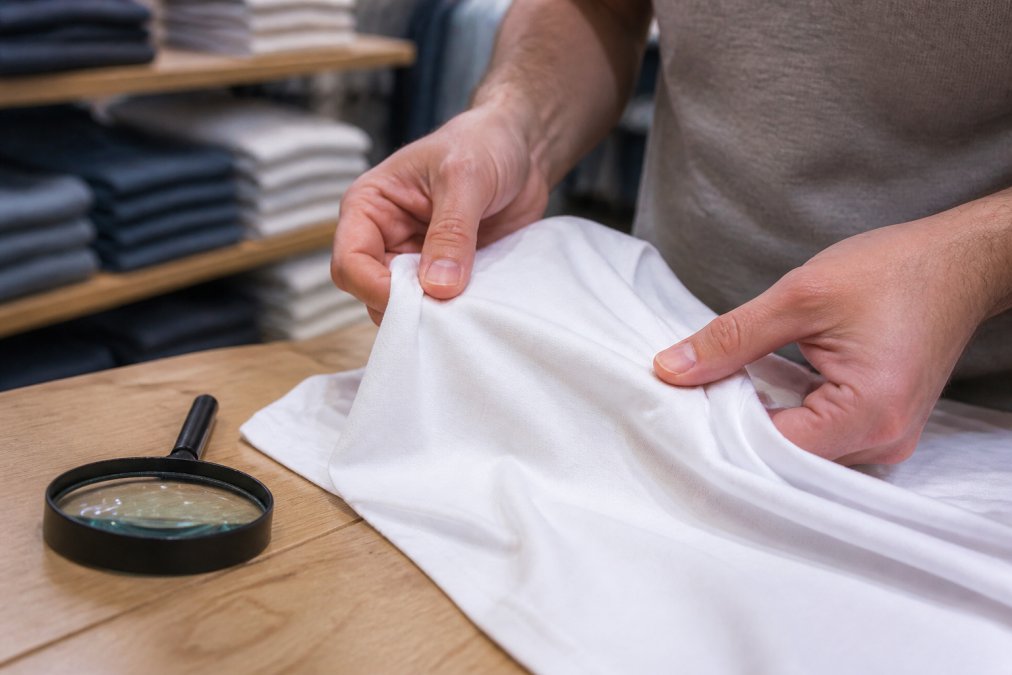
The Touch and Feel Test
Longer cotton fibres feel cool, smooth and slightly weighty. Rub the fabric between thumb and forefinger: slick or plasticky suggests a resin finish or high synthetic content; rough and dry suggests shorter fibres that will pill faster.
The Wrinkle and Recovery Test
Scrunch a section in your fist for five seconds, then release. Quality cotton springs back with only faint creasing; fabric that stays deeply crumpled points to short-staple fibres or a loose weave, both of which wear quickly.
The Water Absorption Test
Drop water on an inconspicuous area. Untreated cotton absorbs it within seconds; if the water beads on the surface, the fabric has a chemical finish or high synthetic blend, reducing breathability.
Fabric Composition: Extra-Long Staple, Combed Cotton, and Blends
Fibre length is the single variable that predicts how a cotton garment looks after a year of wear.
| Fibre or Finish | What It Improves | What to Watch For |
|---|---|---|
| Extra-long staple (ELS) | Strength, smoothness, low pilling | Higher price, less common |
| Combed cotton | Softness, fewer impurities | Moderate cost premium |
| Mercerized cotton | Lustre, colourfastness, strength | Can feel stiffer when new |
| Ring-spun yarn | Smoother hand-feel, tighter twist | Slower, costlier production |
| Open-end yarn | Lower cost, decent durability | Rougher surface, more pilling |
| Cotton-polyester blend | Shape retention, print durability | Lower breathability, holds odour |
| 100% standard cotton | Breathability, natural hand-feel | More prone to shrinkage |
Price-to-Quality: When a High Price Tag Does Not Mean High Quality
Price is a weak proxy for quality in cotton apparel, because much of the retail price goes to brand, marketing and retail margin rather than cloth. A £60 plain tee in 30s Ne combed cotton can sit next to a £25 tee in 40s Ne ELS cotton: the cheaper garment has the better fibre and finer yarn, the pricier one the better-known logo.
Pattern Matching, Alignment, and Finishing Techniques
Pattern matching is the clearest sign a manufacturer cared about the finished garment rather than unit cost. On a striped or checked shirt, lines should run continuously across the side seams, pocket and placket. On printed apparel, check the artwork sits square and no part of the design is cut off by a seam.
Supply Chain Transparency and Certifications to Look For
Traceability is where most apparel brands go quiet, and that silence is informative. A brand that can name its fibre origin, mill or certification body knows its supply chain; one that only says "ethically made" tells you nothing verifiable.
The certifications worth recognising include:
- GOTS (Global Organic Textile Standard): covers organic fibre content and processing, with social and environmental criteria across the chain
- OEKO-TEX Standard 100: tests finished textiles for harmful substances
- BCI (Better Cotton Initiative): a cotton-growing standard focused on farming practice
- Fairtrade textile certification: focuses on producer terms and pricing
The Burn Test and Other At-Home Fiber Identification Methods
The burn test identifies fibre content by how a small sample burns, but needs a spare thread or swatch and a safe, ventilated space. Cotton burns quickly with a paper-like smell and leaves soft grey ash; polyester melts, beads at the edge and smells chemical; a blend shows both behaviours.
Post-Purchase Maintenance: How to Keep Cotton Looking New
Most guides stop at "wash cold, air dry". This section explains why each care choice matters and how to read the care label symbols that govern what a garment can survive, because the quality you identified in the shop is only preserved by the wash cycle you run at home.
Decode the Care Label Before the First Wash
Care symbols are standardised, and the five you will see most often on cotton apparel are:
- Washtub with a number: maximum wash temperature in Celsius. A tub with a bar underneath means a mild or reduced cycle; a tub with a hand inside means hand wash only.
- Triangle: bleaching. A crossed-out triangle means do not bleach.
- Square with a circle: tumble drying. One dot means low heat, two means normal, a cross means do not tumble dry.
- Iron: one dot means low heat (around 110°C), two means medium (around 150°C), three means high (around 200°C).
- Circle: professional cleaning. A crossed-out circle means do not dry clean.
Why Heat and Softener Damage Cotton
Cotton fibres are held together by natural twists and by the twist imparted during spinning. Hot water and tumble drying make fibres swell and contract unevenly, loosening the yarn structure and pushing short fibres to the surface, where they rub together and form pills. It is the same mechanism that makes a cheap short-staple tee pill faster than an ELS tee: more short fibres available to migrate.
Wash Cycles by Garment Type
| Garment | Wash temperature | Cycle | Drying |
|---|---|---|---|
| Plain cotton tee | 30°C | Normal, inside out | Line dry or low tumble |
| Printed tee or hoodie | 30°C | Gentle, inside out | Line dry in shade |
| Heavyweight hoodie (280 GSM+) | 30°C | Normal, inside out | Line dry flat to hold shape |
| Cotton-rich knitwear | 30°C or hand wash | Wool or delicate | Dry flat, never hang |
| White cotton | 40°C | Normal | Line dry in sun |
Wash less often than you think. Cotton is naturally odour-resistant when dry and aired, and a tee worn a day indoors rarely needs a full wash. Airing a garment overnight between wears roughly halves its annual wash cycles, the easiest way to extend its life.
Print and Embellishment Care
Printed apparel has a second failure mode: the ink. Direct-to-garment and screen-printed designs degrade when abraded in the wash or ironed directly. Turn printed garments inside out before washing, avoid biological detergents (enzymes attack some binders), and never iron directly over the print, iron the reverse side or use a pressing cloth.
Frequently Asked Questions
How can I tell if cotton is high quality by touch alone?
High-quality cotton feels soft, smooth, and slightly cool to the touch. It should not feel rough, scratchy, or overly stiff. Extra-long staple (ELS) cotton, such as Supima or Egyptian, feels noticeably silkier and denser than standard cotton.
Is 100% cotton always better than a cotton blend?
Not always. 100% cotton offers breathability, hypoallergenic properties, and a natural hand-feel that many people prefer. However, a small percentage of polyester (like the 65% ring-spun cotton, 35% polyester blend in Proud Pup Club hoodies) can improve durability, reduce shrinkage, and help the garment hold its shape. For everyday wear where easy care matters, a quality blend can outperform pure cotton. The key is the quality of the cotton itself, not just the percentage.
What should I look for in garment construction to ensure quality?
Check seam integrity first. Look for tight, even stitching with no loose threads or skipped stitches. Stitch density should be around 10-12 stitches per inch for durable seams. Pattern matching at the shoulders and side seams shows attention to detail. These construction details often matter more than thread count alone.
How does fabric weight affect the quality of cotton apparel?
Fabric weight, measured in GSM (grams per square metre), directly impacts how a garment drapes, feels, and lasts. Lightweight cotton (under 150 GSM) is breathable but may be sheer and prone to wear. Mid-weight (150-250 GSM) offers a good balance for t-shirts and hoodies. Heavyweight (250+ GSM) feels substantial and durable but can be warmer. For hoodies, 300-400 GSM is common for a premium feel. Higher GSM does not automatically mean better quality; the fibre length and weave tightness matter just as much.
Judging cotton quality comes down to a handful of signals that most shoppers never check: fibre length, GSM, stitch density and honest traceability. Proud Pup Club prints every hoodie to order on a cotton-faced, ring-spun blend, so you can run the touch, wrinkle and water tests on a garment made for you rather than pulled from a warehouse pallet. Shop your breed and put the checklist to work on something you'll actually keep.