
How to Style Dog Decor: A Room-by-Room Guide
Table of Contents
- Dog-Friendly Interior Design Tips That Actually Work
- How to Style Dog Decor Room by Room
- Styling Dog Artwork and Gallery Walls
- Designing a Stylish Dog Crate or Den
- How to Choose Washable Dog Beds for Style
- Small-Space and Budget-Friendly Dog Decor Ideas
- Conclusion
Last Updated: August 21, 2026
Dog decor either looks thoughtfully curated or like a pet supply shop exploded in your living room. This guide covers how to style dog decor room by room, from choosing the right upholstery fabrics to building a gallery wall that would make your breed proud. The right colour palette, materials, and storage choices mean your home can be genuinely stylish and genuinely dog-friendly at the same time.
Dog-Friendly Interior Design Tips That Actually Work
Good dog-friendly interior design means choosing finishes, furniture, and accessories that work with your dog's presence rather than against it. Done well, it's indistinguishable from any other considered interior scheme.
Choosing a Colour Palette That Hides Fur and Looks Intentional
Start with your dog's coat, not your colour preferences. Mid-tones are your best friend. If you have a golden retriever, warm taupes, oat, and sandy linens will absorb shed hair visually. Black Labs call for charcoal, slate, and deep navy. The goal isn't to match your dog exactly, but to choose colours where fur blends rather than contrasts.
Avoid high-contrast schemes if you have a heavy shedder. Instead, opt for tone-on-tone layering: a warm greige base with terracotta and ochre accents reads as intentional and hides a surprising amount.
According to Dulux's colour psychology guide for interiors, neutral and earthy tones are consistently among the most popular choices for UK living rooms, and they happen to be the most forgiving for pet owners.
Choosing Durable, Pet-Safe Upholstery Fabrics
The rub count on a fabric tells you more about its durability than any marketing description. A rub count above 25,000 is considered suitable for heavy domestic use; aim for at least 30,000 for dog owners.
The best upholstery fabrics for pet-friendly homes include:
- Microfibre: Tightly woven, claw-resistant, and easy to wipe down.
- Crypton and performance fabrics: Engineered to resist moisture, odour, and staining. Many are machine-washable.
- Canvas and outdoor-grade textiles: Originally designed for weather resistance, these take a beating without showing it.
- Leather and faux leather: Easy to clean but can show claw marks. Better for dogs who don't scratch.
Avoid chenille, velvet, and loosely woven linens. They trap hair and snag easily.
How to Style Dog Decor Room by Room
Styling dog decor effectively means treating each room as its own spatial planning challenge. The goal is visual harmony: the dog's presence feels integrated, not added as an afterthought.
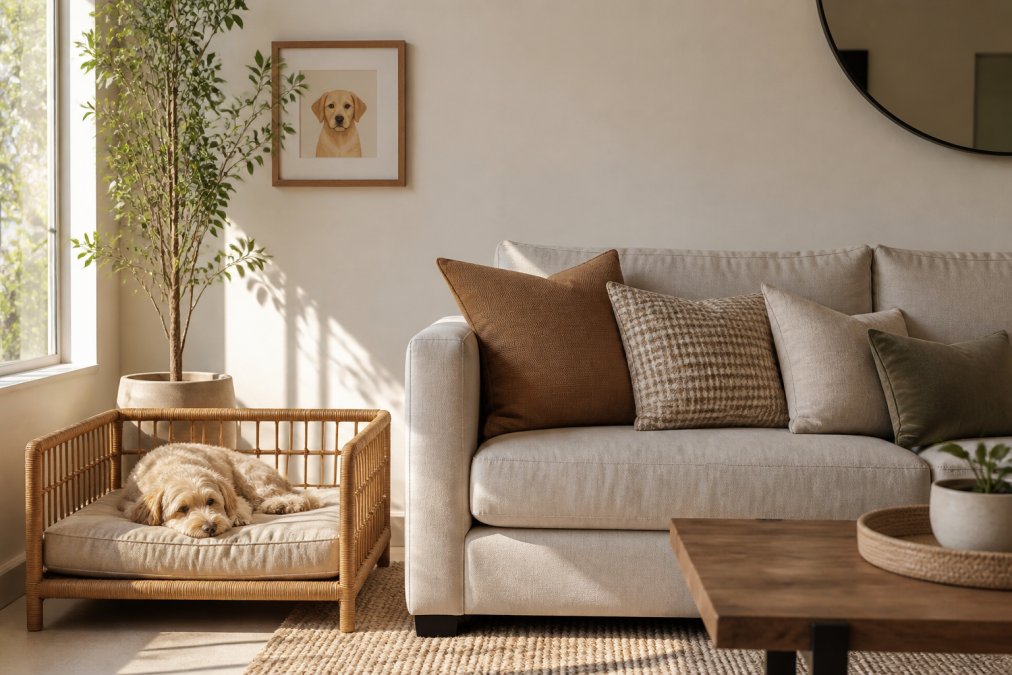
Living Room: Integrating Pet Accessories Without Visual Clutter
The living room is where most dog decor goes wrong. The dog bed is too large, the wrong colour, or plonked in the middle of the room with no visual connection to anything else. Treat the dog bed as a piece of furniture, not an accessory.
Choose a bed that echoes the room's colour palette. A neutral linen or canvas bed in a warm oat or slate tone will disappear into a considered scheme. Position it in a defined zone: tucked beside the sofa, in an alcove, or under a side table.
For pet accessories like leads, toys, and grooming tools, a single basket or storage ottoman does more for a decluttered space than any number of dedicated pet furniture pieces. Choose a basket in a natural material such as seagrass or wicker.
Entryway Organisation for Pet Gear
The entryway takes the most punishment in a dog-owning household. A functional storage system here prevents chaos from spreading through the rest of the home.
A few practical moves that look sharp:
- Dedicated hooks at dog height: A row of hooks at lead-hanging height keeps gear off the floor. Choose hooks in a single finish, brass or matte black, that match other hardware in the home.
- A washable mat or runner: Natural coir or rubber-backed runners handle muddy paw prints without showing every mark.
- A sealed storage bench: Keeps bags of treats, poop bags, and grooming supplies out of sight. A bench with a cushion top doubles as a seat.
- A small wall-mounted cabinet: For harnesses, towels, and wet-weather gear.
Kitchen and Dining: Pet Storage That Blends In
Kitchen kibble chic is achievable. Integrate your dog's feeding station and food storage into the kitchen's existing visual logic rather than treating it as a separate category.
A few approaches that work:
- Matching storage containers: Decant dog food into ceramic or stainless-steel canisters that match your kitchen's existing containers.
- Built-in feeding nooks: A recessed feeding station with bowls set into a pull-out drawer is the most seamless solution.
- Coordinated bowls: Stainless steel or ceramic bowls in a colour that echoes your kitchen's accent palette.
According to the RSPCA's guidance on pet feeding environments, dogs benefit from having a consistent, calm feeding spot away from high-traffic areas. This aligns with the design principle of giving the feeding station a defined zone.
Styling Dog Artwork and Gallery Walls
Dog-inspired artwork is the most direct way to signal your identity as a dog lover through your home decor. A poorly chosen print looks like an impulse buy. A well-curated gallery wall looks like a collector's edit.
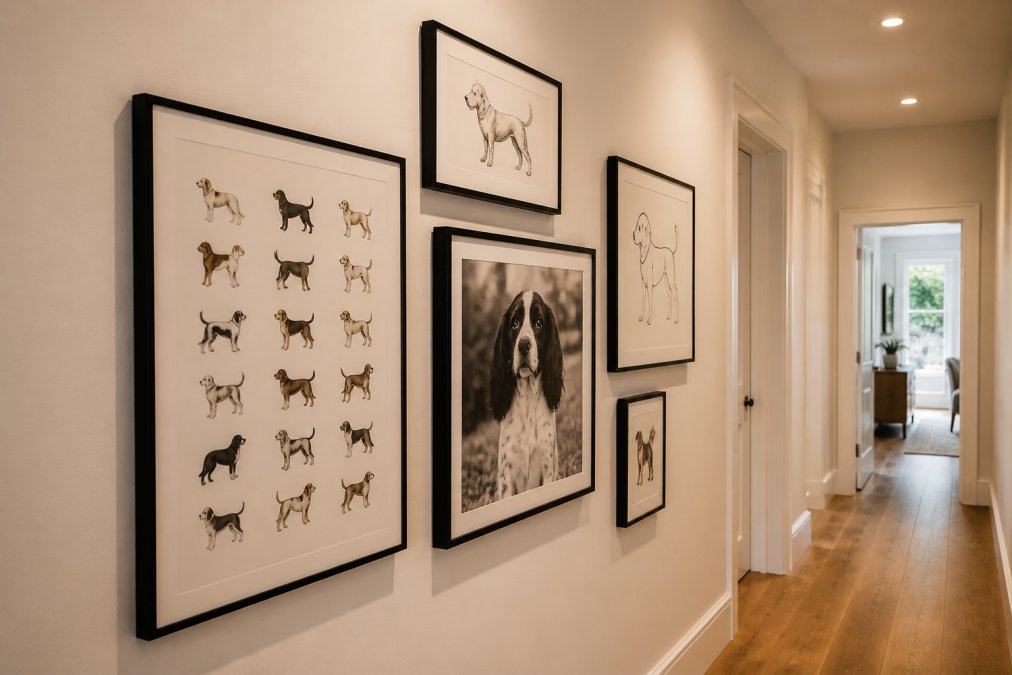
The key to a cohesive gallery wall is constraint. Pick one or two visual themes and stick to them. Breed illustrations paired with black-and-white photography works well. So does a series of the same print style in different sizes.
Frame consistency matters more than most people realise. Choose one frame finish and one or two frame widths. Thin black frames on a warm white wall is a classic combination that works for almost any print style.
For placement, lay your arrangement out on the floor before committing to the wall. The centre of the gallery wall should sit at eye level, around 145-150cm from the floor. Space frames 5-8cm apart for a tight, curated look.
Proud Pup Club's wall art is designed specifically with this kind of gallery wall in mind. Each piece is made to order, so you're getting a print created by people who genuinely obsess over breed-specific detail, not a generic dog silhouette with a breed name underneath.
Designing a Stylish Dog Crate or Den
A designer pet furniture approach to crates starts with one reframe: the crate is furniture, not a cage. Treat it as you would a side table or an armchair.
The most stylish crate solutions currently available tend to fall into three categories:
- Wooden crate furniture: Crates designed to double as side tables or console tables.
- Rattan and wicker dens: Open-weave structures that feel airy and natural.
- Alcove conversions: If you have an understairs space or a recessed alcove, lining it with a cushion and a curtain creates a cozy den that looks entirely intentional.
Whichever structure you choose, the interior matters as much as the exterior. Neutral bedding in a washable fabric keeps the interior looking fresh. Avoid patterned bedding inside a crate, as it tends to look cluttered from the outside.
How to Choose Washable Dog Beds for Style
Choosing washable dog beds for style means balancing practicality with aesthetics. The washable dog bed market has matured significantly, and there are now genuinely attractive options at most price points.
The most important criteria when choosing washable dog beds:
| Criteria | What to Look For | Why It Matters |
|---|---|---|
| Cover material | Removable, machine-washable cover | Keeps the bed hygienic without replacing it |
| Colour | Neutral or tonal to your room palette | Prevents the bed from becoming a visual focal point |
| Fill | Durable foam or recycled fibre | Maintains shape after washing |
| Size | Proportional to the dog and the room | Oversized beds dominate small spaces |
| Base | Non-slip, wipeable underside | Practical and protects flooring |
The most common mistake is buying a bed that's too large for the space. Size it to the dog, not to the idea that bigger is more comfortable.
According to the Kennel Club's advice on dog sleeping environments, dogs benefit from beds that are appropriately sized and positioned away from draughts. A bed that's correctly sized for your dog is also more likely to be proportional to your room.
For washable dog beds that genuinely look good, opt for solid colours or subtle textures over bold patterns. A boucle or waffle-weave texture in a warm neutral reads as interior-led and holds its appearance through repeated washing.
Small-Space and Budget-Friendly Dog Decor Ideas
Small-space apartment solutions for dog decor require a different mindset. Every piece needs to earn its place twice: once as a functional item for the dog, and once as a visual contribution to the room.
The principle of dual-purpose furniture is your starting point. A storage ottoman that doubles as a dog bed base. A window seat with storage underneath for dog gear. A console table with a crate fitted neatly beneath it.
DIY Styling on a Budget
Budget-friendly DIY styling doesn't mean cheap-looking. It means being selective about where you spend and where you improvise.
A few approaches that deliver strong results without significant outlay:
- Frame your own prints: Download high-quality breed illustrations or commission a digital artist. A simple black frame from a high-street homeware shop elevates a printed image significantly.
- Reupholster existing furniture: A dining chair or armchair in a pet-safe performance fabric costs far less than buying new.
- Use baskets as storage: Seagrass and rattan baskets are inexpensive, look considered, and serve as effective toy and accessory storage.
- Paint a feature wall: A single wall in a deep, warm tone creates a backdrop for a gallery wall without the cost of wallpapering an entire room.
- Make a den from existing furniture: An old coffee table with the legs shortened and a cushion added becomes a dog den.
Seasonal Decor Transitions With Pets in Mind
Seasonal decor transitions are where many dog owners fall short. A smarter approach treats the dog's accessories as part of the seasonal palette. In autumn and winter, swap lighter linen dog bed covers for heavier wool or sherpa covers in warm tones. In spring and summer, return to lighter textures and cooler colours.
Pet-safe materials matter here too. Some seasonal decorations, particularly around Christmas and Halloween, include plants and materials that are toxic to dogs. The Dogs Trust's guide to household hazards for dogs is worth bookmarking for any seasonal refresh that involves new plants or decorative items.
Styling a home that works for both you and your dog isn't about choosing between aesthetics and practicality. The challenge is finding pieces that genuinely serve both, and that's exactly what Proud Pup Club was built around. From breed-specific wall art made to order by fellow dog obsessives to home goods that celebrate the bond between owners and their dogs, every piece is designed to earn its place in a considered interior. Shop your breed and find something that makes your home feel like yours.
Frequently Asked Questions
Q: How do you incorporate dog-themed art without cluttering a room?
A: Stick to a consistent frame style and colour, matching black or natural wood frames instantly unify mismatched prints. Treat dog-inspired artwork the same way you would any gallery wall: odd numbers of pieces, varied sizes, and a clear visual anchor at eye level. Limit dog art to one focal wall per room rather than spreading it across every surface. This keeps the look intentional rather than overwhelming, and lets each piece breathe.
Q: What are the best materials for stylish, washable dog beds?
A: Removable covers in canvas, outdoor-grade linen, or microfibre are the most practical choices. Look for covers that are machine-washable at 40°C or higher and have a rub count above 20,000 for durability. Waterproof inner liners protect the filling from accidents. Neutral tones like oatmeal, slate, and charcoal blend into most colour palettes. Avoid velvet or bouclé for the main bed cover, they trap hair and are harder to clean thoroughly.
Q: What colour palettes work best for dog-friendly home decor?
A: Mid-tone neutrals, warm greiges, soft terracottas, and muted greens, are the most forgiving for pet hair and muddy paw prints. Very light or very dark solids show everything. If your dog sheds heavily, choose upholstery and bedding in a tone close to their coat colour. Introduce pattern through cushions and rugs rather than large furniture pieces, as patterned textiles disguise daily wear far better than plain fabrics.
Q: How can I make a dog crate look like a piece of furniture?
A: Choose a crate with a wooden or rattan exterior rather than bare wire. Place it inside a built-in alcove or beside a bookcase so it reads as part of the room's structure. Drape a neutral throw over the top to double as a side table surface. Add a washable cushion inside that matches your existing soft furnishings. Keeping the area around the crate tidy and free of scattered toys reinforces the impression that it belongs in the room by design.
This article was written using GrandRanker