
Minimalist Dog Art for Walls: 7 Styles to Elevate Your Home
Table of Contents
- Why Minimalist Dog Art Works in Modern Homes
- One-Line Illustration: The Signature Style
- Monochrome and Abstract Approaches
- Building a Dog Gallery Wall: Layout and Display Ideas
- Minimalist Pet Line Art: Choosing Your Aesthetic
- Room-Specific Styling: Where Your Dog Art Belongs
- Custom and Personalised Prints
- Quality, Framing, and Sustainability
- Frequently Asked Questions
Last Updated: September 2, 2026
Why Minimalist Dog Art Works in Modern Homes
Minimalist dog art has become the go-to choice for dog lovers who want to celebrate their pets without cluttering their walls with cutesy clichés. Clean lines, intentional design, and a timeless aesthetic make it work whether your décor leans Scandi, contemporary, or somewhere in between. A single continuous line drawing of your breed captures your dog's essence in its purest form, saying more than a photorealistic portrait ever could.
Modern homes demand restraint. Minimalist dog art functions as both a personal statement and a design element, celebrating your relationship with your dog while enhancing your space rather than overwhelming it.
At Proud Pup Club, we focus on three breeds, Dachshunds, French Bulldogs, and Golden Retrievers, because we'd rather perfect three than produce fifty half-heartedly. Every design is made to order, reflecting the artistry and care that goes into celebrating your dog.
One-Line Illustration: The Signature Style
What Makes One-Line Art Special
One-line art captures movement, personality, and breed character in the simplest possible way. A single unbroken contour requires no shading, detail work, or flourish, just the outline of your dog, drawn as if a pencil never left the paper.
By removing everything except the line itself, you force the design to be pure. The viewer's eye traces the path of the drawing and, in doing so, traces the shape of your dog. It's intimate without being sentimental, striking without being loud. One-line art feels modern because it mirrors contemporary design thinking: reduction, clarity, purpose.
Popular Breeds in One-Line Design
Certain breeds translate beautifully into one-line art. The best candidates have distinctive silhouettes that are instantly recognisable.
Dachshunds are perhaps the most iconic one-line subject. Their elongated bodies, short legs, and characteristic profile are unmistakably a Dachshund in a single continuous line. The Dachshund One-Line Hoodie at Proud Pup Club captures this perfectly at £44.99.

French Bulldogs present an interesting challenge. Their compact, muscular build and bat-like ears need careful line work to remain recognisable, but when done right, a Frenchie's one-line portrait is unforgettable. The French Bulldog One-Line Hoodie demonstrates how the breed's distinctive silhouette reads instantly, also at £44.99.

Golden Retrievers, with their flowing coat and balanced proportions, lend themselves beautifully to line art. The Golden Retriever One-Line Hoodie captures this balance, with flowing lines suggesting movement without requiring detail work.

Monochrome and Abstract Approaches
Beyond one-line illustration, monochrome and abstract minimalist dog art offers different ways to celebrate your breed while maintaining a clean, contemporary aesthetic. Monochrome designs create visual impact through contrast and composition rather than colour variation.
Abstract approaches distil your dog into geometric shapes, negative space, or simplified forms that suggest the breed without depicting it literally. These designs appeal to dog lovers who appreciate art for its own sake and want their wall décor to function as actual art rather than pet merchandise.
The advantage of monochrome work is its flexibility. Black and white prints work in virtually any interior scheme and age better than colour work, which can fade as colour trends shift.
Building a Dog Gallery Wall: Layout and Display Ideas
Spacing and Arrangement Principles
A dog gallery wall works best when it follows basic design principles. Start by choosing a focal point, your largest piece, favourite print, or most central position. Arrange other pieces around it, maintaining consistent spacing between frames. Many designers use the "two-inch rule": leave approximately two inches between frame edges for a cohesive look.
Consider the grid versus the organic approach. A grid layout feels contemporary and orderly. An organic or salon-style arrangement feels more curated and personal. Both work; the choice depends on your space and aesthetic preference.
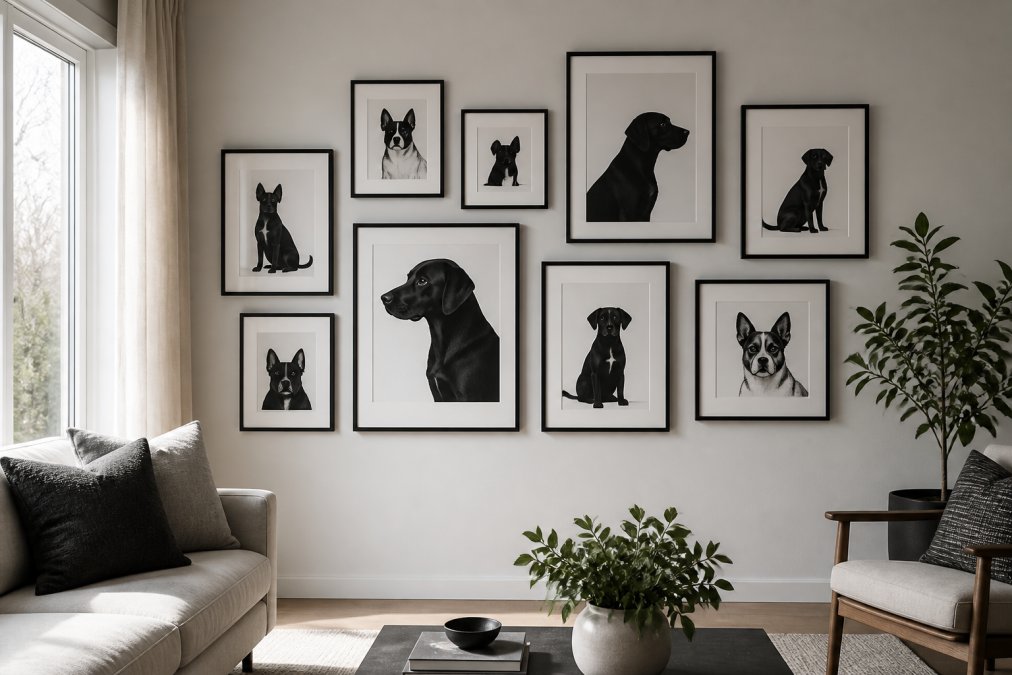
Centre your arrangement at eye level, roughly 145 centimetres from the floor to the centre of your gallery. This creates a natural focal point.
Mixing Frames and Unframed Prints
Unframed prints mounted directly to the wall or placed in simple clips create a contemporary, gallery-like feel. They work particularly well for minimalist dog art, where simplicity benefits from minimal visual framing.
Framed prints add formality and protection. Black frames are the safest choice for minimalist work. Natural wood frames introduce warmth and work well in Scandi or contemporary farmhouse settings. White or cream frames create a softer look in light, airy spaces.
If mixing frame styles, ensure there's a clear reason, size variation, print type, or a deliberate eclectic aesthetic, rather than random choices.
Minimalist Pet Line Art: Choosing Your Aesthetic
Geometric and Silhouette Options
Geometric interpretations push minimalism further by replacing realistic outlines with angular, abstract forms. A Dachshund might become triangles and rectangles suggesting its elongated shape. These designs appeal to people who want art that's dog-inspired rather than dog-representational.
Silhouette art, solid black shapes against white or light backgrounds, offers another minimalist approach. A silhouette captures your breed's profile instantly and works beautifully in modern interiors. Silhouettes work particularly well for breeds with distinctive profiles: Dachshunds, French Bulldogs, and Golden Retrievers all translate into instantly recognisable silhouettes.
These pieces function as abstract art first and dog art second, which means they appeal to a broader audience and integrate seamlessly into any design scheme.
Scandi Style and Contemporary Finishes
Scandi style emphasises simplicity, natural materials, and a limited colour palette. Minimalist dog art fits perfectly into this aesthetic. Pairing a one-line or geometric dog print with natural wood frames, soft textures, and neutral colours creates a cohesive Scandi-inspired space.
Contemporary finishes incorporate premium materials and thoughtful presentation. High-quality paper stocks, matte, semi-gloss, or textured finishes, elevate a print from basic merchandise to a design piece. Matte finishes feel more sophisticated and reduce glare, while semi-gloss adds subtle depth.
Made-to-order production means your print is created with care, not pulled from a warehouse shelf. The quality of the paper, precision of printing, and attention to detail all contribute to a finished piece that works as actual art.
Room-Specific Styling: Where Your Dog Art Belongs
Living Rooms and Entryways
Living rooms and entryways are ideal homes for dog art. In a living room, consider the wall space above a sofa, console table, or accent wall. A single large piece creates more impact than multiple smaller ones. A one-line or geometric print becomes a conversation starter.
Entryways benefit from dog art because it sets the tone immediately. A minimalist dog print communicates something about who you are: someone who loves their dog but has taste, someone who values design.
Scale is critical. For a living room wall, consider a piece at least 40 centimetres in one dimension. For an entryway, a medium-sized print (30-50 centimetres) usually works best, positioned at eye level.
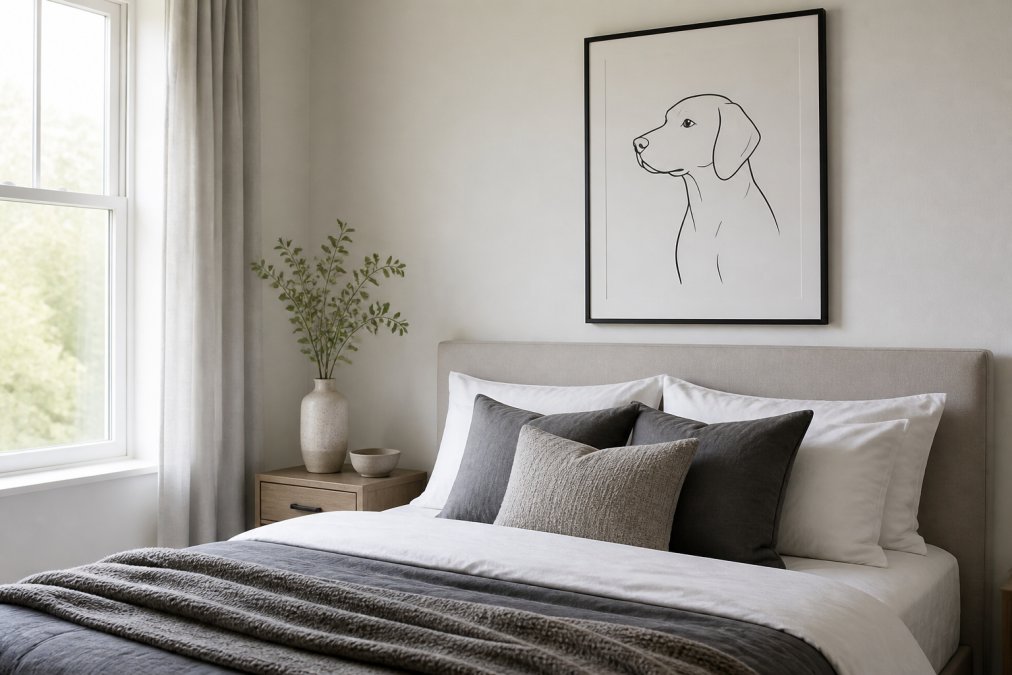
Bedrooms and Home Offices
Bedrooms call for a more personal approach. A minimalist dog print above the bed becomes a focal point seen first thing in the morning and last thing at night. Keep the scale generous.
Home offices benefit enormously from minimalist dog art. A one-line print on the wall behind your desk or on a side wall adds personality without distraction. It's the kind of detail that makes a workspace feel intentional and lived-in rather than sterile.
The key in both spaces is intentionality. Choose one strategic location and let it breathe. A single well-placed piece is far more powerful than multiple prints competing for attention.
Custom and Personalised Prints
Custom minimalist dog art creates a design specific to your dog rather than choosing a breed-standard print. Custom work requires a clear reference image, ideally a profile shot showing your dog's distinctive features. The best custom dog art captures something true about your dog's character: the tilt of the head, the curve of the ears, the particular way your dog stands or moves.
Made-to-order production ensures each piece is created with intention. Rather than ordering from a generic catalogue, you're commissioning a piece created specifically for you.
Quality, Framing, and Sustainability
Premium Finishes and Paper Types
Premium art paper, typically 200 gsm or heavier, feels substantial and professional (peer-reviewed research on paper specifications). Matte finishes reduce glare and create a gallery-like appearance. Semi-gloss or satin finishes add subtle depth and make colours appear slightly richer.
Fine art giclée printing uses archival-quality inks that resist fading and maintain colour accuracy for decades. Cheaper printing methods use inks that degrade quickly, especially when exposed to sunlight. If you're investing in a piece you plan to keep long-term, printing quality is worth the extra cost.
Eco-Friendly Printing and Made-to-Order
Made-to-order production is inherently more sustainable than mass manufacturing. Rather than producing thousands of prints and hoping they sell, each print is created only when someone orders it. This eliminates warehouse waste and ensures resources are used efficiently.
Printing on sustainable paper stocks, recycled paper, FSC-certified materials, or papers made from agricultural waste further reduces environmental impact. For dog lovers who care about sustainability, these choices represent a genuine commitment to minimising harm.
A single minimalist dog print you love and keep for years beats a rotating collection of cheap prints you replace annually.
Minimalist dog art for walls works because it respects both your dog and your space. It's a way to celebrate your pet without sacrificing design integrity, to make a personal statement without shouting. Whether you choose a one-line illustration, a geometric interpretation, or a custom portrait, the best pieces are those created with intention and made with care.
At Proud Pup Club, we believe dog lovers deserve better than generic merchandise. Our minimalist dog art is designed by people who genuinely care about both dogs and design. Every piece is made to order, created specifically for you. Shop your breed and bring home a piece of art that honours the dog who's stolen your heart.
Frequently Asked Questions
Q: What is minimalist dog art and why is it popular for walls?
A: Minimalist dog art strips away detail to focus on essential lines, shapes, and silhouettes. It works well in modern homes because it complements neutral colour palettes, doesn't compete with other décor, and creates visual calm. One-line illustrations, monochrome designs, and geometric silhouettes are all forms of minimalist dog art that appeal to owners who want to celebrate their pets without bold, decorative styles.
Q: How do I create a dog gallery wall with minimalist pet line art?
A: Start with an anchor piece, usually a larger print. Arrange smaller pieces around it using consistent spacing (roughly 5-8 centimetres between frames). Mix frame styles and unframed prints to add visual interest. Plan your layout on the floor first using paper cutouts, then mark the wall before hanging. Odd numbers of pieces and asymmetrical arrangements feel more contemporary than perfectly symmetrical grids.
Q: What breeds work best in minimalist dog art designs?
A: Breeds with distinctive silhouettes translate beautifully into minimalist styles. French Bulldogs, Dachshunds, and Golden Retrievers are popular because their shapes are instantly recognisable in simplified form. However, any breed can work in minimalist art if the design captures its key characteristics, ears, body proportions, or posture, rather than fine details like fur texture or eye expression.
Q: Are there eco-friendly options for custom dog wall art?
A: Yes. Made-to-order printing eliminates warehouse waste and overstock, reducing environmental impact compared to mass production. Look for brands using high-quality, sustainable paper stocks and eco-conscious printing methods. Made-to-order also means your art is printed only after you order, so nothing goes to waste. Many small makers prioritise sustainability as part of their production model.
This article was written using GrandRanker