
Minimalist Dog Lover Home Decor Ideas for 2026
Table of Contents
- 1. Start With a Neutral Palette and Clean Lines
- 2. How to Choose Washable Dog Beds for Style
- 3. Durable Fabrics for Dog Owners: Rugs, Sofas and Throws
- 4. Built-In Dog Crates and Bespoke Pet Furniture
- 5. Minimalist Dog Lover Home Decor: Wall Art and One-Line Prints
- 6. Functional Storage and Decluttering Dog Accessories
- 7. Sustainable and Budget-Friendly Minimalist Dog Decor
- Frequently Asked Questions
Last Updated: September 13, 2026
1. Start With a Neutral Palette and Clean Lines
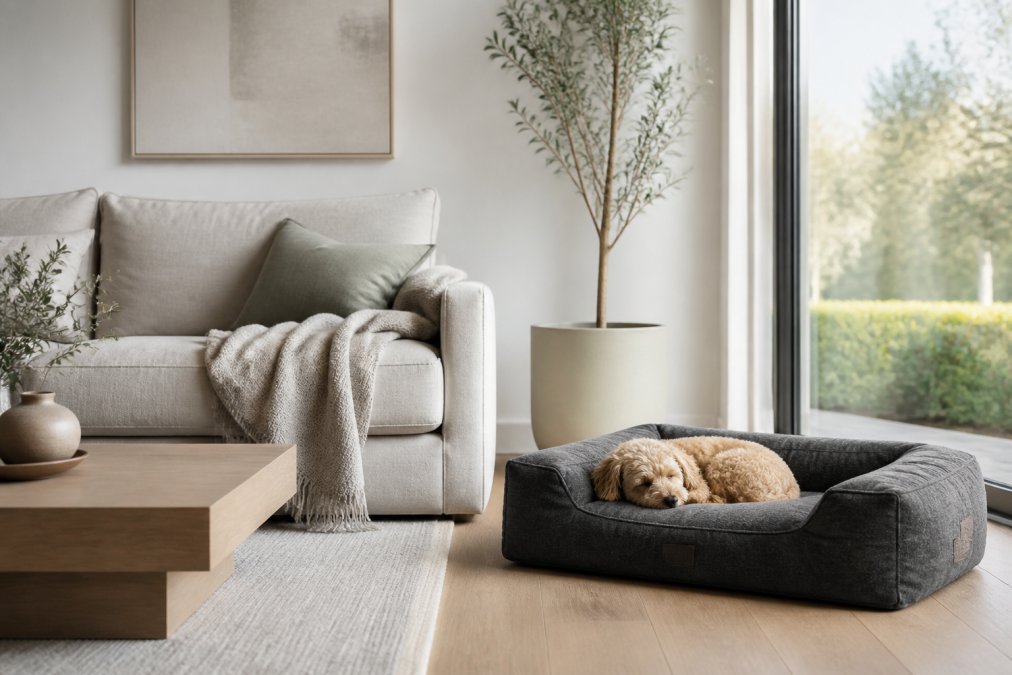
Minimalist dog lover home decor ideas begin with restraint: a neutral palette, clean lines, and a floor plan that leaves room for the dog to move. In practice, that means choosing two or three base tones, then letting one textured piece carry the visual weight.
The mistake most people make is treating the dog's things as exceptions to the scheme. A bright plastic crate, a patterned bed, a rainbow of toys. Each one is small, but together they fragment the room.
Instead, pick a base of warm white, oatmeal, charcoal or soft grey, then repeat those tones across the dog's bed, bowls and storage. Visual harmony comes from repetition, not from hiding the pet gear.
A few principles that hold up:
- Choose two neutrals and one accent, then stop
- Keep furniture legs visible so sightlines stay open
- Match the dog bed to the sofa fabric rather than the floor
- Use one material family, such as oak, linen and wool
2. How to Choose Washable Dog Beds for Style
The best washable dog bed is one whose cover unzips fully, washes at 30°C, and matches your existing textiles rather than announcing itself as pet furniture (the NHS). Style follows function here.
Look for these specifics before you buy:
- Removable cover with a full-length zip, not a partial opening
- Machine washable at 30°C so the cover survives repeat cycles
- A neutral colourway that hides light shedding without looking grey
- A non-slip base if the bed sits on hardwood or laminate
- A spare cover so the bed is never out of action on wash day
Wash frequency matters more than most guides admit. A common approach is to wash the cover weekly and the inner cushion monthly, which keeps odour down without wearing out the fabric (rspca.org.uk).
Aesthetically, a rectangular bed with a low profile reads calmer in a contemporary home than a donut shape. If your dog insists on curling, a bolster bed in a matching neutral still works, provided the bolster is firm enough to hold its shape after washing.
3. Durable Fabrics for Dog Owners: Rugs, Sofas and Throws
Durable fabrics for dog owners come down to weave density and cleanability, not to marketing labels. Tight weaves resist claw snags; loose weaves trap hair and dirt.
For rugs, a flat-weave or low-pile option in a mid-tone works best. Washable rugs with a rubber backing are the practical choice in high-traffic rooms, and they handle muddy paws far better than deep pile. Wool is naturally stain-resistant and hides dirt well, though it costs more and needs gentler cleaning (textileinstitute.org).
| Surface | Best Fabric Choice | Why It Works | Watch Out For |
|---|---|---|---|
| Rugs | Flat-weave or washable cotton | Easy to shake out and machine wash | Deep pile traps hair |
| Sofas | Tight-weave linen blends | Resists snags, hides light shedding | Loose weaves pull easily |
| Throws | Cotton or cotton-linen | Washes hot, dries fast | Acrylic pills over time |
| Cushions | Removable covers only | Cover goes in the wash, insert stays | Fixed covers are a dead end |
Sofas are the harder problem. A tight-weave linen blend in a mid-grey or oatmeal handles daily use without showing every mark. Leather is another option, though it scratches, and scratches on leather are permanent, not washable.
4. Built-In Dog Crates and Bespoke Pet Furniture
Modern dog crate integration means the crate stops being a cage in the corner and becomes a piece of joinery. Built-in cubbies under a window seat, a crate that doubles as a side table, or a low unit with a slatted door all do the same job: they give the dog a den without breaking the room's lines.
Three approaches worth considering:
- Under-stair cubby. Uses dead space, keeps the crate out of the main sightline.
- Crate-as-console. A timber top turns the crate into a surface for a lamp or a mug.
- Slatted door panel. Gives airflow while reading as furniture rather than mesh.
Bespoke pet furniture costs more than a flat-pack crate, and that is the honest trade-off. The upside is a piece sized to your dog, your room and your materials, which usually outlasts two or three cheap replacements.
If you rent, or if you are not ready to commission joinery, a freestanding crate in a dark neutral with a timber top gets most of the visual benefit for a fraction of the cost. The key is consistency: match the timber and hardware to the rest of the room.
5. Minimalist Dog Lover Home Decor: Wall Art and One-Line Prints
Minimalist dog lover home decor works best when the dog imagery is reduced to a single confident line. One-line prints, framed in thin black or oak, sit comfortably in a neutral room where a photo collage would not.
The reason is simple. A one-line drawing carries the breed's silhouette in one unbroken contour, so it reads as art first and dog reference second. A Dachshund's long back, a Frenchie's bat ears, a Golden's soft head: all of that survives the reduction to a single line, which is exactly why the style has held up.
Choosing the artwork
Three formats do the heavy lifting in a minimalist scheme:
- One-line prints. A single unbroken contour of the breed. Best in A3 or A2, printed on matte uncoated stock so there is no glare.
- Framed black-and-white pet photography. A tight crop of the muzzle, paw or ear reads as abstract texture rather than a pet portrait. High-contrast monochrome suits a charcoal or warm-white wall.
- Silhouette cut-outs. A solid black or oak-veneer profile mounted on a shadow box. Works well above a dog bed or crate console.
Avoid: multi-panel photo grids, paw-print motifs, and anything with a script caption. These are the details that tip a room from considered to themed.
Scale, spacing and hanging
Most practitioners find that one large piece beats three small ones in a minimalist room, because a single frame leaves more wall breathing. As a rule of thumb:
- Artwork should span roughly two-thirds to three-quarters of the width of the furniture below it.
- Hang at eye level, around 145cm to 152cm from the floor to the centre of the frame.
- Leave 5cm to 8cm between frames if you group two or three, and keep the outer edges aligned.
- Keep the bottom of the frame 15cm to 25cm above a sofa back or console top.
A single larger print usually looks more considered than a gallery wall of small ones, and it leaves the wall breathing.
Frames and finishes
Frame choice matters more than the print in a neutral room. Thin profiles in black, oak or brushed brass sit best. Wide ornate mouldings fight the restraint. Use anti-glare glazing if the wall faces a window, and choose a mount (passe-partout) in the same tone as the wall so the artwork appears to float.
For anyone who wants the same aesthetic on themselves rather than the wall, Proud Pup Club prints the same one-line Dachshund, French Bulldog and Golden Retriever artwork on made-to-order hoodies at £44.99, alongside mugs at £15.99 and organic cotton totes at £22.99. Each piece is printed after you order rather than held in a warehouse, which is the brand's approach to avoiding unsold stock.

A note on pet photography
If you want to use your own dog, shoot against a plain wall in soft daylight, convert to black and white, and crop tight. Print at A3 on matte paper and frame in oak. The result reads as minimalist art rather than a snapshot, and it costs far less than a commissioned portrait.
6. Functional Storage and Decluttering Dog Accessories
Functional storage is what keeps a minimalist home from drifting back into clutter. The rule: every dog item gets a fixed home, and that home is closed.
Practical storage that fits a clean scheme:
- A lidded basket for toys, in the same material as your other baskets
- A shallow drawer near the door for leads, harnesses and poo bags
- A wall hook rail at dog height for the lead, so it never lands on a chair
- A sealed container for food, kept off the floor and out of sight
- A single tray for bowls, so water spills stay contained
Decluttering dog accessories is less about throwing things away and more about capping the number. Two toys out, the rest stored. One lead in use, one spare. Rotating toys weekly keeps the dog interested and the floor clear.
A common mistake is buying open storage because it looks tidy in photographs. In a real home with a real dog, open baskets collect hair and show every stray tennis ball. Closed storage with a lid is the version that survives contact with daily life.
7. Sustainable and Budget-Friendly Minimalist Dog Decor
Sustainable minimalist decor starts with buying less and choosing materials that age well. For dog owners, that usually means natural fibres, solid timber and products made to order rather than mass-produced.
Where the budget goes furthest:
- Second-hand timber furniture, sanded and refinished in a neutral tone
- Organic cotton or jute baskets, which compost or biodegrade at end of life
- Washable cotton throws instead of synthetic fleece
- One good piece rather than five cheap ones that need replacing
Made-to-order production is a genuine lever here. When a product is printed or built only after it is ordered, there is no warehouse full of unsold stock to discount, landfill or incinerate. That is a structural difference, not a marketing line, and it is why small made-to-order brands can compete on sustainability without claiming more than they deliver.
DIY minimalist pet furniture
Most results stop at buying. These three builds cost little and match a neutral scheme:
- Crate cover from a plain cotton sheet. Measure the crate, add 2cm seam allowance, hem all four sides, and add a flap opening at the front. A double flat sheet from a charity shop works well and costs a few pounds.
- Painted MDF plinth for bowls. Cut a piece of 18mm MDF to 40cm x 25cm, sand the edges, prime and paint in the same colour as the wall, then attach two stainless steel bowls with silicone rings. This lifts food off the floor and contains spills.
- Timber frame around a standard crate. Build a simple open box from 44mm x 44mm planed timber, stain in oak or walnut, and slide the crate inside. The frame reads as a console table and the crate stays removable for cleaning.
For material guidance on textiles and finishes, the Textile Institute publishes reference material on fibre performance.
Maintenance and cleaning for minimalist homes with dogs
Minimalism is hard to maintain with pets. A short routine keeps it that way:
- Daily: shake out throws and rugs, wipe hard floors with a damp microfibre mop, and put toys back in the lidded basket.
- Weekly: wash the dog bed cover at 30°C, vacuum upholstery with a rubber pet-hair attachment, and wipe skirting boards where hair collects.
- Monthly: wash the inner cushion, launder sofa covers if removable, and check the underside of rugs for grit that abrades the weave.
- Seasonally: rotate throws and cushion covers, and review whether any item has stopped earning its place.
GOV.UK carries current guidance on product safety and labelling if you are buying or making items for pets. For more on how interior choices affect the animals living in the space, the RSPCA publishes practical guidance on creating a comfortable home environment for dogs, including advice on resting areas and routines.
Frequently Asked Questions
How can I incorporate dog-themed decor without making my home look cluttered?
Stick to one or two statement pieces rather than scattering dog motifs everywhere. A single framed one-line print or a minimalist dog mug on an open shelf adds personality without noise. Choose neutral tones and clean lines so the dog-themed element becomes a focal point, not background clutter. Rotate accessories seasonally to keep the look fresh without accumulating more items.
What are the best minimalist materials for pet-friendly home accessories?
Look for organic cotton, linen, wool and durable microfibre. These fabrics resist claw snags, wash well and fit a neutral palette. For furniture, solid wood or powder-coated metal works better than veneer, which chips. Ceramic mugs and stoneware bowls are heavier and less likely to slide. Avoid synthetic blends that pill quickly, and choose materials that can be cleaned with a damp cloth or machine washed.
How do I choose washable dog beds that match a minimalist aesthetic?
Choose a bed with a removable cover you can machine wash at 30°C, ideally in a neutral colour like oatmeal, charcoal or sage. Look for a simple shape such as a low-profile mattress or a bolster with clean seams. Memory foam holds its shape better than loose filling and looks tidier. Measure your dog's sleeping position first, then pick a size that fits your floor plan without crowding walkways.
Where can I find high-quality, made-to-order dog art for modern interiors?
Proud Pup Club offers one-line breed-specific designs printed to order, so nothing sits in a warehouse. Their mugs (£15.99) and tote bags (£22.99) use minimalist line art that suits neutral interiors. Each piece is made after you order, which reduces waste and means you get a design created by fellow dog lovers rather than mass-produced generic imagery.
What colour palettes work best for a minimalist dog-friendly home?
Stick to warm neutrals: off-white, oatmeal, taupe, charcoal and soft grey. These hide light dog hair better than pure white and blend with most furniture. Add one accent colour such as forest green or navy for depth. Avoid busy patterns on rugs and upholstery; a subtle texture like bouclé or linen weave adds interest without visual noise. Monochrome decor with one wood tone keeps the space calm.
A minimalist home with a dog in it takes more planning than either one alone. The rooms that work are the ones where the dog's bed, bowls, crate and toys were chosen as part of the scheme rather than added afterwards. Proud Pup Club makes that easier with one-line breed designs on hoodies, mugs and organic cotton totes, all printed to order so nothing sits in a warehouse waiting for a buyer. Shop your breed and build the room around it.